
Paying more for less? The 10% mandatory copayment proposal
India’s health insurance market is growing but is also under financial pressure. Total health insurance premiums reached ₹1,27,417 crore in FY25, according to IRDAI’s Annual Report. But growth in premium income is being outpaced by growth in claims. The industry-wide Incurred Claims Ratio (ICR) for health business stood at 87% in FY24-25, with public sector insurers facing even sharper pressure. For standalone health insurers, ICRs have touched 90% or above, meaning that after paying claims, almost nothing remains to cover operating costs.
The driver is medical inflation. Medical inflation in India runs at approximately 14-15% annually, more than triple the general consumer inflation rate of around 4%. The average health insurance claim has increased by over 30% in just three years. This increase ultimately lands directly on policyholders. Individual policies have become 23% costlier between FY23 and FY25. For family floater plans, the increase since 2021 is around 46%. One year after the GST on health insurance was removed, policyholders are still facing renewal premium hikes of 25% to 41%, because the base cost of medical services keeps rising faster than the tax savings.
The General Insurance Council proposal
A General Insurance Council meeting in early October 2026 resulted in a proposal that non-life insurers want to introduce a mandatory 10% copayment on inpatient hospitalisation costs for retail health insurance policies, proposed to take effect from 1 January 2027.
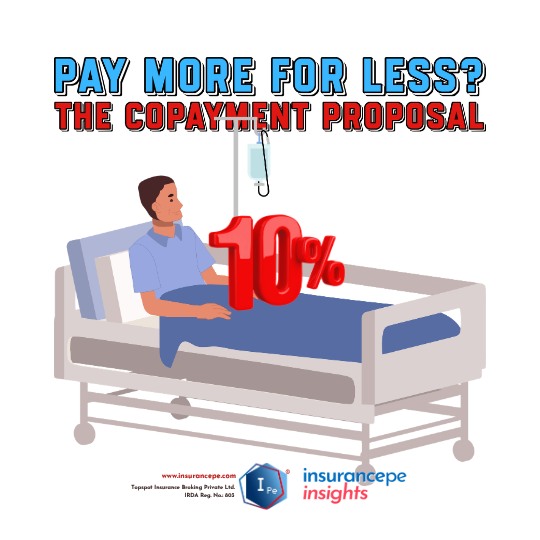
A copayment means that when you are admitted to hospital and make a claim, you bear 10% of the eligible bill yourself, and the insurer covers the remaining 90%. On a ₹2 lakh hospitalisation, that is ₹20,000 out of your pocket, every time, regardless of how long you have been paying premiums.
The stated rationale from insurers is that the move aims to make policyholders more conscious of healthcare costs and encourage them to contain hospitalisation expenses, particularly high room rents. The argument is that when insurance pays the full bill, neither patients nor hospitals have an incentive to question costs, a phenomenon economists call moral hazard. There is genuine academic evidence for this: a widely cited German study found that premium refund programmes significantly reduced doctor visits for trivial ailments, particularly in younger and healthier individuals.
However, industry executives note that the proposal is unlikely to receive IRDAI’s nod if presented as an industry-wide initiative, because implementing it collectively would raise cartelisation concerns. Individual companies could introduce copayments in their products under the use-and-file system without regulator approval. Several insurers already offer products with copayments ranging from 10% to 30%, particularly for senior citizens or for treatment in higher-category cities. What is new here is the suggestion of an industry-wide baseline.
“Skin in the game”
The proponents of copayment have a legitimate argument, and it deserves a fair hearing before being challenged.
When an insurance policy covers 100% of a hospital bill, neither the patient nor the hospital has a strong financial incentive to question costs. A patient who knows insurance will pay in full may choose a premium private room they don’t clinically need. They may consent to additional diagnostic tests without asking whether they are strictly necessary. And hospitals knowing the insurer is paying, have an incentive to bill at the highest rates, recommend additional procedures, and push premium consumables rather than generic equivalents.
Introducing a 10% copayment theoretically makes the insured more aware: if you bear ₹20,000 of a ₹2 lakh bill, you may ask more questions. You may choose a standard room over a deluxe one. You may ask if a certain test is really necessary. The theory is that financial participation sharpens the policyholders’ attention. This is the “skin in the game” argument.
Does this argument hold for inpatient claims which the proposal targets?
When you book a routine outpatient consultation, you are in a position to compare, delay, question, and decide. When you are admitted to hospital after a cardiac event, a road accident, an acute infection, or a surgical emergency, you are not shopping around. You are not in a position to, nor do you generally care about negotiating with the hospital about whether a procedure is necessary or a consumable is required. You simply want to get better with minimal financial hassle in the moment. If a treatment is genuinely needed, which is the overwhelming majority of inpatient claims, the copayment does not reduce costs at all. It simply redistributes them from the insurer to the patient.
How are other countries handling this
Many countries use cost-sharing mechanisms in health insurance, but their outcomes are instructive rather than simply encouraging.
- Germany introduced a €10 per quarter doctor visit charge in 2004, explicitly to reduce unnecessary consultations. It was abolished in 2013 after studies found it reduced necessary visits among low-income patients more than it reduced unnecessary ones, and increased administrative burden without proportionate cost savings.
- Switzerland operates a system of mandatory 10% coinsurance with an annual out-of-pocket cap (around CHF 700), which does appear to reduce overuse, but Switzerland also has highly regulated hospital pricing, so the cost-sharing is operating within a system where providers cannot simply inflate bills in response.
- And then there is the cautionary case: the United States.
The US health system is the world’s most extreme example of cost-sharing without cost regulation. American health plans routinely carry annual deductibles of USD 1,000-5,000 before insurance pays anything, followed by copayments and coinsurance on top. Hospitals charge inflated sticker prices specifically because insurance is expected to pay. As a result, the US spends a higher share of GDP on healthcare than any developed country, yet significant portions of the population remain inadequately covered or forgo necessary treatment due to cost. Medical debt is a leading cause of personal bankruptcy in the United States.
This happens when there is no provider-side price regulation in a for-profit hospital environment. The copayment does not reduce the bill, it just shifts who pays. If India introduces copayments without simultaneously regulating what hospitals can charge, the system might end up as it did in the US.
A senior executive at a private-sector non-life insurer made precisely this point: “Rising hospital costs are affecting both the insured and uninsured. Instead of introducing co-payment, insurers should seek the creation of a health regulator that can regulate hospital costs.”
The penetration problem
India’s health insurance penetration remains critically low. Total lives covered stands at a fraction of the population, with out-of-pocket expenditure still accounting for over 43% of India’s total health spending, one of the highest ratios in Asia. India’s “Insurance for All by 2047” ambition requires dramatically expanding the insured population, particularly among lower-middle-income households and the informal sector.
A mandatory copayment sort of goes against that goal. For the existing middle-class policyholder, 10% is an inconvenience. For a family earning ₹30,000-₹50,000 a month, for whom a ₹5 lakh hospitalisation already feels expensive, knowing that they will still face ₹50,000 out of pocket even with insurance may drive them further away from buying insurance.
Over 52% of policyholders already experienced premium increases of more than 25% in the last 12 months, with real coverage shrinking even as premiums rise. Adding a mandatory copayment to that environment is a significant additional burden on policyholders’ trust in the product and on the case that health insurance is worth buying. So will a mandatory copayment really help spread coverage?
So, what should we do?
Health insurance systems inevitably run into a cost problem. Copayment may be a short-term fix to a long-term problem.
The structural reforms that would be more promising to address this is a dedicated hospital cost regulator with powers to moderate pricing for insured procedures; standardised clinical protocols to reduce unnecessary interventions; mandatory disclosure of treatment costs; and stronger negotiating frameworks between insurers and hospital networks. India currently does not have a hospital cost regulator. The Jan Swasthya Abhiyan (JSA) and the Working Group on Access to Medicines and Treatment have made a step in the right direction by calling for regulation in this regard amid scrutiny by the Supreme Court of pricing practices in hospital pharmacies.
Another recommendation would require a reinvention and revamp of government hospitals as primary, mandatory and universal medical care providers, with private insurance only covering what remains uncovered by government hospitals. This will require a drastic change in mentality of “government hospitals are for the poor” and of course, the conditions in government hospitals are not a topic for this discussion.
As of early October 2026, the proposal remains a discussion within the General Insurance Council and it is unknown and seems unlikely that the IRDAI would approve this. Individual insurers may introduce copayments on specific products through the use-and-file route.
Meanwhile, if you need advice or help tracking specific sub-limits, copayments and deductibles in your health insurance, feel free to reach out to insurancepe.
This blog post is brought to you by the minds at insurancepe!
Got questions or doubts about anyone insurance?
Need advice or help understanding your insurance needs?
Want the best bang for your buck when buying insurance?
We got you!
Reach out to us at:
Whatsapp/Phone: 89779 18030
E-mail: contact@insurancepe.com
Visit us at www.insurancepe.com