
A BRICS backed insurance ecosystem
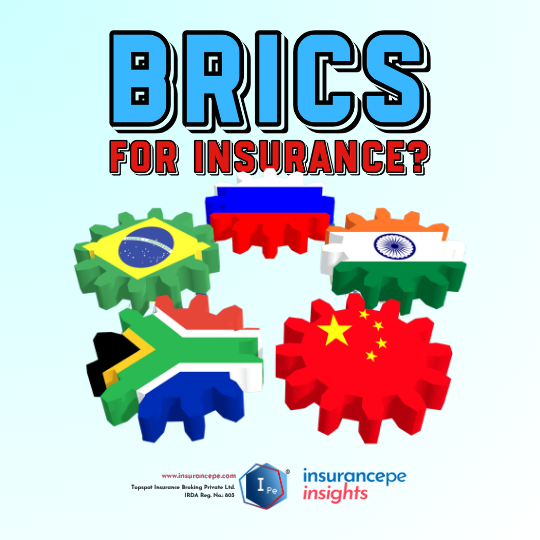
BRICS began as an acronym coined by a Goldman Sachs economist in 2001 to describe the world’s fastest-growing emerging economies: Brazil, Russia, India, China, and South Africa. It became a formal diplomatic grouping in 2009. Since then, its growth has been remarkable, creating opportunities for a BRICS backed insurance ecosystem.
In 2024, Egypt, Ethiopia, Iran, the United Arab Emirates, and Saudi Arabia joined as full members. Indonesia followed in 2025. Ten more nations, including Kazakhstan, Malaysia, Nigeria, Thailand, and Vietnam, became partner countries. BRICS now brings together 11 major emerging economies representing approximately 49.5% of the global population, around 40% of global GDP, and approximately 26% of global trade.
The 18th BRICS Summit was held in New Delhi on 12 and 13 September 2026, under India’s chairmanship and the theme “Building for Resilience, Innovation, Cooperation and Sustainability.” The summit delivered nearly 350 meetings across various working groups over the course of the year. And among the most consequential outcomes was a set of proposals around insurance.
The BRICS insurance proposal
The New Delhi Declaration 2026, adopted at the close of the summit, calls for exploring a BRICS Insurance Resilience Centre (BIRC) as a voluntary shared-capability platform. The proposed centre would support the development of common risk models, exchange of best practices, and creation of specialist insurance capabilities across member countries.
Members also agreed to continue discussions on strengthening their reinsurance capacity through the voluntary participation of regulators and reinsurance companies from BRICS jurisdictions. The most concrete institutional proposal is India’s BRICS Risk Lab to be hosted at the GIFT City International Financial Services Centre (IFSC) in Gujarat, open to participation by interested BRICS members. If developed, the initiative could strengthen GIFT City’s role as a platform for cross-border financial cooperation and create opportunities for Indian financial-services companies, insurers, reinsurers, brokers and risk-management firms.
Separately, Russian President Vladimir Putin called for building a standalone insurance mechanism for the BRICS bloc, including for grain trade. He described it as a “promising initiative” open to voluntary adoption by members, though he provided no operational detail on structure, underwriting capacity, or timeline. Iranian President Masoud Pezeshkian went further, calling for the creation of a dedicated BRICS reinsurance company with initial capital of $10 billion, to reinsure major infrastructure and energy projects and help mobilise private-sector investment.
Importantly, GIC Re, India’s state-owned national reinsurer, chaired meetings of the BRICS Task Force on Reinsurance Cooperation throughout India’s chairmanship, positioning it as a central player in whatever institutional architecture eventually emerges.
These proposals currently are declarations of intent. No new institution has been capitalised, licensed, or made operational. The BRICS New Development Bank, the bloc’s most advanced financial institution, took years from founding declaration to disbursing its first loans. Any BRICS insurance body will require the same patient construction.
How does this benefit India
- As a host nation: A BRICS Risk Lab at GIFT City would position India, and specifically GIFT City IFSC, which is already attracting international reinsurers, as the intellectual and technical centre of a $1.82 trillion insurance market projected to reach $3.45 trillion by 2034, according to DataCube Research. India’s GIC Re and GIFT City’s growing cadre of international insurers give India the infrastructure to run such a facility credibly.
- As an insurance buyer: India is a net importer of reinsurance capacity, particularly for large natural catastrophe risks, and large commercial projects. Indian insurers cede significant portions of their premium to international reinsurers in Europe and Bermuda. A functioning BRICS reinsurance capacity pool could diversify that dependency and, if priced competitively, reduce the cost of protection on large commercial risks.
- As a risk-modelling centre: The global natural catastrophe protection gap reached approximately USD 424 billion in 2025, according to Swiss Re, with only around 27% of global protection needs insured. The BRICS region, includes some of the world’s highest-risk geographies for earthquakes, floods, cyclones, and climate risks, and has the greatest need for better catastrophe risk models and the least access to them. A shared risk lab focused on South Asian, African, and South American peril zones would fill a real gap in global insurance knowledge.
The risks and the realities
Concentration and accumulation risk arise when a reinsurance pool lacks sufficient geographic and peril diversification. The great strength of the international reinsurance market is precisely its global spread: a loss from a hurricane in Florida is offset by premium income from earthquake risks in Japan and marine risks in the North Sea. A BRICS reinsurance pool, by contrast, would be heavily concentrated in geographies with correlated exposures. A single large catastrophe season affecting multiple BRICS markets simultaneously could simultaneously stress the pool’s claims and impair its capital base.
Capitalisation adequacy: International reinsurers are rated by agencies such as AM Best, S&P, and Moody’s and must meet rigorous solvency standards. A new state-backed BRICS reinsurance entity, particularly one that includes sanctioned institutions, would need to demonstrate comparable financial strength before major cedants would trust it with large risk transfers.
Regulatory standards uniformity: BRICS members span an enormous range of insurance regulatory frameworks, from India’s IRDAI, China’s NFRA, and Brazil’s SUSEP to the nascent frameworks of Ethiopia and Indonesia. Common risk models, shared data standards, and mutually recognised solvency requirements would all require years of negotiation. Differences in regulation, underwriting practices, data standards, capital requirements and claims frameworks across member countries will need to be addressed.
Quality-of-cover: International reinsurers backed by Lloyd’s, Solvency II, and IAIS standards provide a high level of confidence that claims will actually be paid. A new mechanism’s claims-paying reliability would need to be established through track record and similar strict solvency and risk frameworks, not just declarations of intent.
The BRICS insurance market is large, growing, and underserved. The proposed institutions to serve it will have to address a real underlying demand and large protection gap, which has been a concerning insurance problem.
This blog post is brought to you by the minds at insurancepe!
Got questions or doubts about anyone insurance?
Need advice or help understanding your insurance needs?
Want the best bang for your buck when buying insurance?
We got you!
Reach out to us at:
Whatsapp/Phone: 89779 18030
E-mail: contact@insurancepe.com
Visit us at www.insurancepe.com