No SLOPPY policy wording, says the Supreme Court
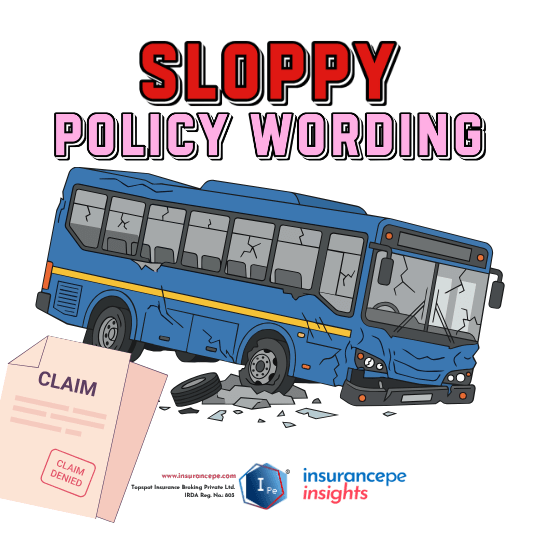
In 2010, a bus set off from Durg in Chhattisgarh on a religious pilgrimage, carrying passengers to destinations including Nepal. The Supreme Court’s observation—“No sloppy policy wording” The bus held a valid special permit issued by the Regional Transport Authority under the Motor Vehicles Act, authorising cross-border travel. At the India-Nepal border, authorities verified the vehicle’s documents and cleared it through.
The journey ended tragically. The bus collided with a hill in Nepal, killing three people including the driver, Riaz Khan, and passenger Harish Yadav. Yadav’s wife, children, and mother filed a compensation claim of ₹48.99 lakh before the Motor Accident Claims Tribunal (MACT). The Tribunal directed the vehicle owner to pay. The Chhattisgarh High Court then reviewed the matter and shifted the liability to the vehicle’s insurer (Oriental Insurance Company) directing it to pay ₹32.67 lakh with interest.
Oriental Insurance appealed to the Supreme Court, arguing one central point: the accident happened outside India, and therefore outside the scope of the policy.
The Court’s finding
The insurer’s argument rested on a “Geographical Area” clause in the policy that referred to India. But the Supreme Court looked at the whole policy, not just the clause most convenient for the insurer. Another section, the “Limitations as to Use” clause, covered vehicles operating under a valid permit. Since the bus was travelling to Nepal on a lawfully issued special permit under the Motor Vehicles Act, the court held that the “Limitations as to Use” clause was the operative provision, and it provided coverage.
The insurer had also argued that the driver had no licence valid outside India. The court rejected this too: the driver held a valid Indian licence, and Nepalese border authorities had accepted it, as permitted under the 1950 India-Nepal Treaty of Peace and Friendship. There was no breach of licence conditions.
The critical observation came in how the court characterised the insurer’s conduct. “When the party with all the drafting power writes an ambiguous policy, it is the ordinary policyholder who suffers. Insurers have, in many cases, exploited this ambiguity, either to escape liability which they should rightfully bear, or, conversely, found themselves burdened with liability they never intended to assume, simply because their policy language was sloppy.”
And then, the line that will define this judgment in the history of Indian insurance law:
“Cover what you want. Exclude what you want. But make sure you do it clearly. Sloppy drafting could cost you something.”
To know more about this Supreme Court ruling, click here.
Contra Proferentem
The Supreme Court’s ruling is anchored in a long-established legal doctrine called contra proferentem, Latin for “against the one who offers.” The rule holds that when an insurance contract contains an ambiguous term capable of more than one interpretation, the ambiguity must be resolved in favour of the insured, against the drafter of the policy.
This is not a new principle in Indian law. The Supreme Court has invoked contra proferentem repeatedly in United India Insurance vs. Pushpalaya Printers (2004), Sushilaben Gandhi vs. New India Assurance (2020), and multiple three-judge bench decisions since. But the July 2026 ruling gave it its most quotable formulation yet, and applied it in the context of cross-border motor insurance, that had never been clearly addressed.
The Bombay High Court also applied the same principle in September 2025, holding that a widow’s claim under a credit-linked insurance policy bundled with a housing loan could not be denied because the policy’s language was ambiguous, ruling firmly that if the insurer created the ambiguity, the insurer bears the consequences.
The logic is straightforward: insurance policies are standard-form contracts drafted entirely by the insurer. The policyholder has no bargaining power, no say in the wording, and often limited financial literacy. As the Supreme Court has noted in earlier judgments, insurance companies frequently use legal and technical language that is hard for the average consumer to understand. Where that language creates ambiguity, the drafter, not the customer, should bear the cost.
A directive to the IRDAI
The Supreme Court held that there is currently no clear statute, binding precedent, or regulatory framework that specifies whether a domestic motor insurance policy extends to countries where an Indian vehicle is lawfully permitted to travel.
The court directed IRDAI to consider issuing a master circular standardising cross-border coverage clauses across all motor insurance policies in India. It suggested two concrete requirements:
- first, if a policy excludes cross-border coverage, it must say so explicitly;
- second, insurers must proactively inform policyholders that they will need a separate endorsement before travelling across an international border, similar to how international travel health insurance is currently communicated.
The court also took aim at the Motor Accident Claims Tribunals themselves, noting that many MACT orders lack “adequate and clear reasoning” recording evidence and submissions at length without actually correlating them to the facts or the outcome, resulting in avoidable appeals and delayed compensation for claimants who can least afford to wait.
If you are travelling with an insured vehicle outside India: Check your motor policy for geographical coverage clauses, and ask your insurer or broker whether your existing policy extends to your destination country or whether an endorsement is needed.
If you are buying any insurance product: Read the exclusions, not just the benefits page. If an exclusion is unclear, ask for a written clarification. If the insurer cannot clearly tell you what is and is not covered, the court system and the doctrine of contra proferentem, has consistently said that ambiguity does not serve the insurer.
The Supreme Court’s words are a comfort and a caution simultaneously: comfort, because the law is clearly on the side of the policyholder when ambiguity exists; caution, because it still takes years, sometimes decades, of litigation to get there. The solution is a policy that says clearly from the first page exactly what it covers and what it doesn’t.
This blog post is brought to you by the minds at insurancepe!
Got questions or doubts about anyone insurance?
Need advice or help understanding your insurance needs?
Want the best bang for your buck when buying insurance?
We got you!
Reach out to us at:
Whatsapp/Phone: 89779 18030
E-mail: contact@insurancepe.com
Visit us at www.insurancepe.com