E20, Ethanol blending & motor insurance – Lessons from Brazil

India achieved a milestone that arrived ahead of schedule and with little fanfare for the millions of vehicle owners it directly affected. The government’s target of 20% ethanol blending in petrol (E20) was originally set for 2030. It was fast-tracked to 2025, and by mid-2025, E20 had become the only fuel available at nearly all of India’s 90,000 petrol stations. The older blends E5 and E10, which most vehicles on Indian roads were designed for are no longer offered.
This national fuel policy change left millions with no alternative but to use a fuel their vehicle was not engineered to run on.
Why E20?
E20 is a blend of 80% petrol and 20% ethanol, a biofuel typically produced from sugarcane, grain, and agricultural waste. Its introduction is driven by two complementary goals.
-
- The first is environmental. Ethanol burns cleaner than fossil fuels, producing lower carbon emissions and reducing particulate matter.
-
- The second is economic. India is the world’s third-largest consumer of crude oil and imports over 85% of its petroleum needs, a significant drain on foreign exchange. Ethanol, by contrast, is produced domestically, and India is already the third-largest ethanol producer globally. Every litre of ethanol blended into petrol is one less litre of imported crude.
The government’s National Bio-Energy Policy and Ethanol Blending Programme (EBP) laid the framework for this transition, with E20 compatibility becoming mandatory for all new vehicles from April 2023. The policy has broad support from automakers, regulators, and environmental groups, the debate is not about whether E20 is a good idea, but about how the transition is managed.
Is your car compatible?
All new cars sold in India from April 2023 onwards are designed to handle E20 without any problems. However, vehicles produced before this date may face challenges.
-
- Post-April 2023 vehicles: E20-compatible. Engines, seals, fuel injectors, and rubber components are all engineered for the higher ethanol content.
-
- BS6 Phase 2 vehicles (approx. 2022–2023): Material compatibility is largely assured, though engine recalibration for ethanol was only mandated from April 2023. Minor efficiency variation is possible.
-
- BS6 Phase 1 / BS4 vehicles (pre-2022): Engines designed for lower ethanol blends. E20 may degrade rubber fuel hoses, seals, and gaskets faster than normal. Fuel pump and injector wear is a risk in engines not designed for higher ethanol content.
-
- Pre-BS4 / older vehicles: Highest risk category. These were designed for E5 or E10 at most and are most vulnerable to accelerated component wear.
If you own a pre-2023 vehicle, checking your manufacturer’s compatibility guidance and having rubber fuel components inspected at an authorised service centre is strongly advisable.
The insurance question (feat. ICICI Lombard)
The concern is if E20 causes gradual damage to fuel system components in an older vehicle, will a motor insurance claim for that damage be paid?
ICICI Lombard initially flagged that E20-related damage claims in older vehicles may not be straightforward, noting that standard motor insurance policies typically exclude consequential damage, that is, damage that develops progressively over time rather than resulting from a single insured event like an accident. A FAQ published by the insurer also noted that engine protection add-ons, while useful, are typically designed for issues like water ingress or oil leakage and may not automatically extend to chemical corrosion from fuel.
However, after these concerns gained widespread attention, ICICI Lombard issued a clear clarification: using E20 fuel does not invalidate a motor insurance policy and is not treated as negligence, even in older vehicles. The insurer confirmed that claims are assessed based on whether an insured event has occurred, and that the type of fuel used is not a determining factor in claim admissibility.
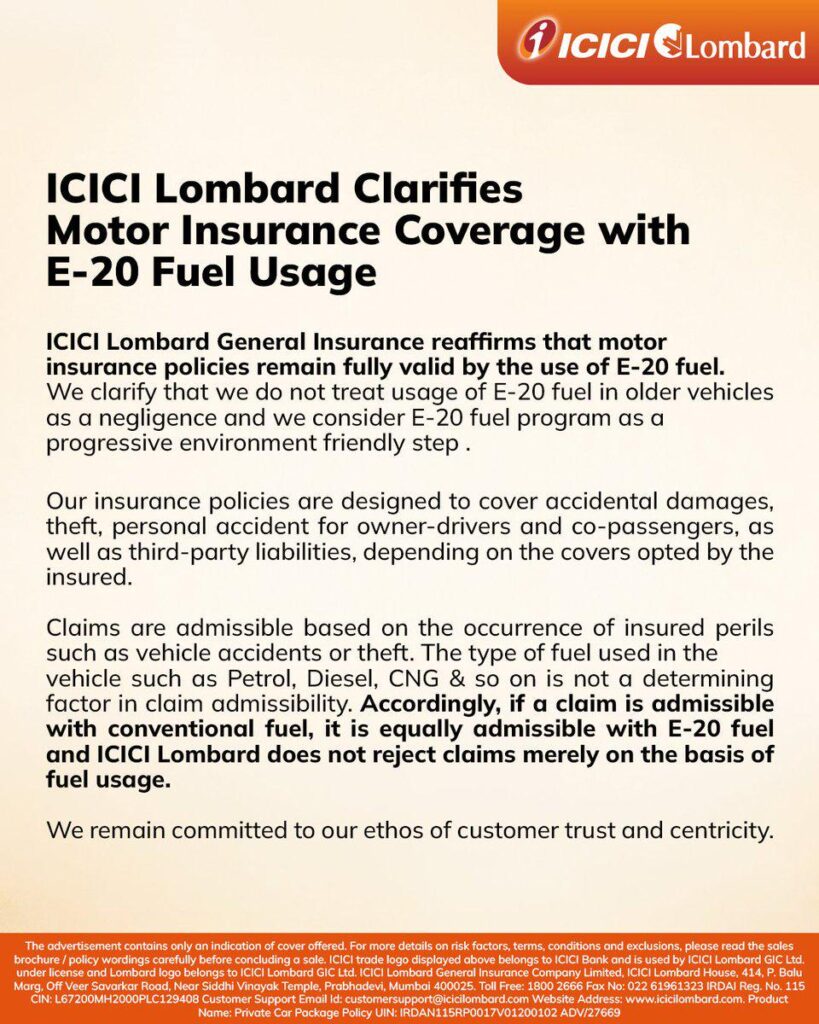
In short, accidental damage triggered by an insured event remains covered regardless of fuel type. But slow, cumulative degradation of seals, hoses, or fuel system components, even if accelerated by E20, is likely to be assessed as wear and tear, which falls outside standard policy coverage.
Brazil’s fifty-year experience with Ethanol
India is not the first country to navigate this transition.
Brazil launched its national ethanol programme, PROÁLCOOL, in 1975, following the 1973 oil crisis. Sharing India’s twin goals of reducing crude oil import dependency and leveraging domestic agricultural capacity, in Brazil’s case, abundant sugarcane rather than grain, the programme resulted in the first commercially available ethanol-powered car (E100), a Fiat 147, going on sale in July 1979.
The early Brazilian E100 cars were not without problems. Challenges included corrosion of materials in contact with the new fuel, leaks, difficulty starting in cold weather, and gum formation in carburettors. Swelling of rubber seals in contact with ethanol eventually caused leaks, issues that were solved gradually over time through engineering improvements. These were treated as manufacturing and warranty problems, solved at the vehicle level by carmakers, not as insurance disputes.
In 2003 Volkswagen introduced the first flex-fuel vehicle (FFV) in Brazil. A flex-fuel engine can run on any combination of petrol and ethanol, from pure petrol to pure E100, adjusting automatically via software and sensors. Today, nearly all new vehicles sold in Brazil are flex-fuel capable.
But what about the motor insurance aspect?
Because Brazilian vehicles were designed for their fuel from the start, the “incompatible fuel” exclusion problem simply did not become an insurance issue. The early engineering challenges were absorbed as warranty and manufacturing matters, not claims disputes.
While Brazil took many years and solved the problem before it reached the insurance industry, by ensuring vehicles and fuel evolved together, India is attempting a compressed version of that journey, and the friction is falling on vehicle owners in the middle.
The transition works best when consumers have genuine choice. Brazilian drivers can switch between petrol and E100 at the pump based on whichever delivers a lower cost per kilometre, using what is known as the “70% rule”: if ethanol costs less than 70% of petrol’s pump price, it is the cheaper option per kilometre driven.
Encouragingly, India’s flex-fuel roadmap is taking shape. Carmakers including Maruti Suzuki, Toyota, Honda, and Hero MotoCorp have begun showcasing flex-fuel-ready vehicles, and the Bureau of Indian Standards notified IS 19850:2026 in May 2026, covering E22 to E30 blends, the next step on a trajectory that Brazil completed two decades ago.
The road ahead is well mapped. The question is how smoothly India manages the transition for the millions of vehicle owners caught between a new fuel policy and an insurance framework still catching up to it.
What should vehicle owners do?
E20 is not going away, and these blends are likely only going to increase with E30, E40 and beyond. As a vehicle owner and policyholder, you should:
- Check your vehicle’s E20 compatibility on your manufacturer’s website or owner’s manual. Maruti, Hyundai, Tata, Honda, and most major manufacturers have published guidance.
- Get your fuel system regularly inspected, particularly rubber hoses, gaskets, and seals, at an authorised service centre, especially if your vehicle was manufactured before 2020.
- Review your motor insurance policy, specifically the exclusions around consequential damage and the scope of any engine protection add-on you hold.
- Document any performance changes, reduced mileage, unusual engine behaviour, increased service frequency, as records may be important if a claim arises.
This blog post is brought to you by the minds at insurancepe!
Got questions or doubts about anyone insurance?
Need advice or help understanding your insurance needs?
Want the best bang for your buck when buying insurance?
We got you!
Reach out to us at:
Whatsapp/Phone: 89779 18030
E-mail: contact@insurancepe.com
Visit us at www.insurancepe.com