India’s health check
India’s healthcare landscape is undergoing a significant shift. The latest Survey on Household Consumption: Health by the NSO (National Statistics Office) highlights a country where access to healthcare is improving, but disease patterns and financial risks are evolving rapidly.
The rise of Lifestyle diseases
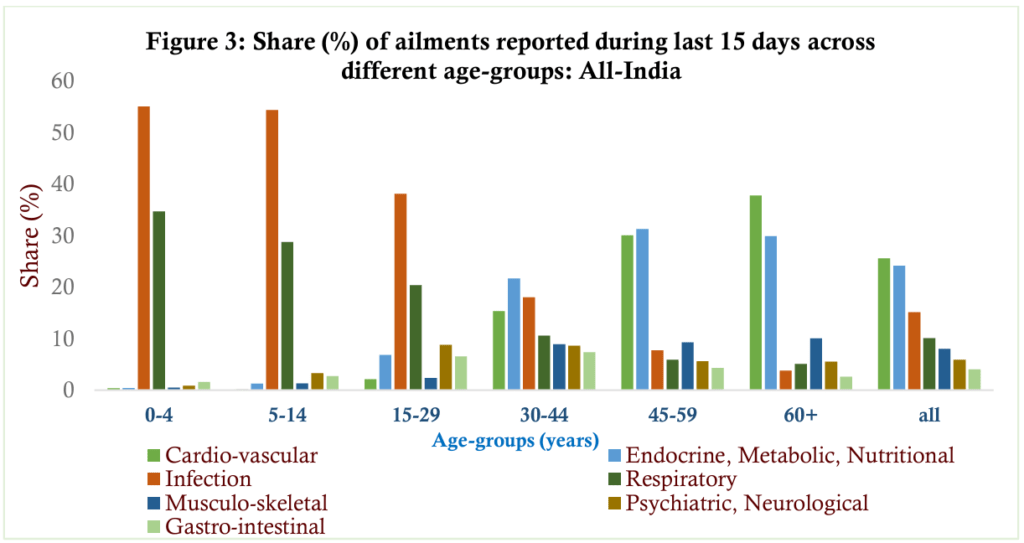
One of the most striking findings is the surge in non-communicable diseases (NCDs). These are conditions such as hypertension, diabetes, heart disease, thyroid disorders etc. which are now becoming dominant after the age of 30, replacing infectious diseases as the primary health concern.
This reflects changing lifestyles such as sedentary habits, stress, and dietary shifts and it means health risks are no longer strictly episodic, they have evolved to be long-term and chronic.
Infectious diseases are declining
While lifestyle diseases are rising, infectious diseases have declined significantly. Earlier, infections like fever, diarrhoea, and respiratory illnesses dominated, but now, their share has reduced, especially among adults.
However, children remain vulnerable, with infections still forming a major share of ailments in younger age groups. India might be witnessing a dual burden of disease with declining yet present infections, but rising chronic illnesses.
More people are falling ill
The survey reveals a sharp increase in reported illness with 13.1% of Indians reported illness in the last 15 days in 2025, compared to 7.5% in 2017-18.
The rise is especially steep among people aged 60+ (43.9%) and age group 45–59 (22.5%). This could suggest:
- Better detection and reporting
- But also a genuine increase in disease burden
The cost of Healthcare & OOPME
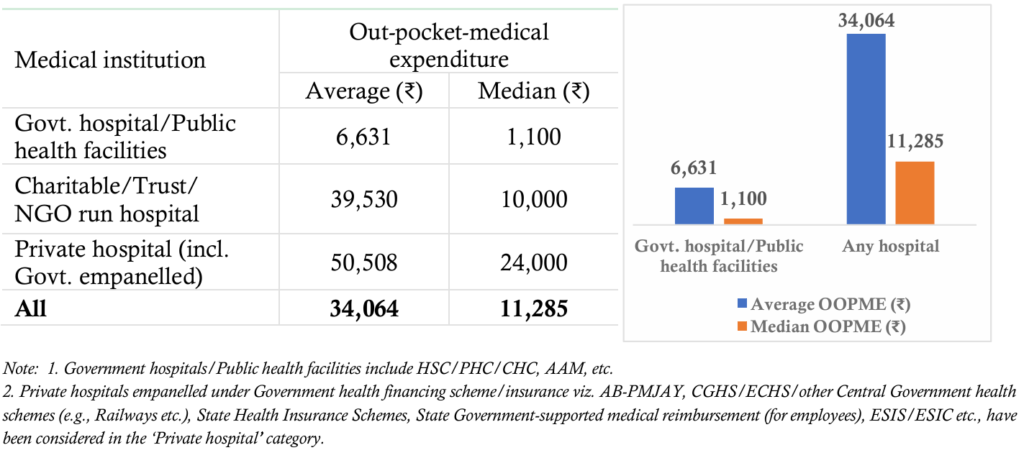
The survey shows that healthcare is becoming more expensive. The average out-of-pocket cost per hospitalisation: ₹34,064
Private hospital costs are significantly higher, often exceeding ₹50,000 per hospitalisation. Even routine medical events can now lead to substantial financial strain.
Despite progress, a large portion of healthcare costs is still borne directly by households out of pocket.
Out-of-pocket medical expenditure (OOPME) continues to account for a major share of total healthcare spending and it includes expenses from savings, borrowings, or asset sales.
Even with insurance coverage expanding, financial protection is not yet complete. This means that a medical emergency can still disrupt household finances.
A positive trend: Insurance coverage is rising
There is, however, a major positive development. Health insurance coverage has expanded significantly:
- ~47% in rural areas
- ~44% in urban areas
This is a sharp increase from the previous survey cycle. Much of this growth is driven by government-sponsored schemes, which have improved access for previously uninsured populations.
But coverage does not mean full protection
While nearly half the population is now covered, the survey highlights a key gap.
Many schemes primarily cover hospitalisation (inpatient care) and outpatient care, diagnostics, and medicines often remain uncovered.
This leads to continued out-of-pocket spending even among insured individuals. In other words, insurance penetration has improved, but coverage depth still needs work.
Public vs Private healthcare
The report also highlights a stark contrast:
- Public hospitals have an average cost of ~₹6,631
- Private hospitals have significantly higher average costs at ~₹50,508
Private hospitals may grant faster access, but at a premium.
This explains why public healthcare remains critical for affordability while private healthcare drives higher insurance utilisation
The report points to a clear reality:
- Chronic diseases require long-term financial planning
- Medical costs are rising faster than income growth
- Insurance is becoming a necessity, not an option
This means, it’s time for you to:
- Reviewing existing health insurance coverage
- Ensuring adequate sum insured
- Considering policies that cover outpatient and chronic care
Getting insured is a smart decision. But getting adequately insured is smarter.
This blog post is brought to you by the minds at insurancepe!
Got questions or doubts about anyone insurance?
Need advice or help understanding your insurance needs?
Want the best bang for your buck when buying insurance?
We got you!
Reach out to us at:
Whatsapp/Phone: 89779 18030
E-mail: contact@insurancepe.com
Visit us at www.insurancepe.com