Nvidia’s $900m insurance that won’t pay for lawsuits?
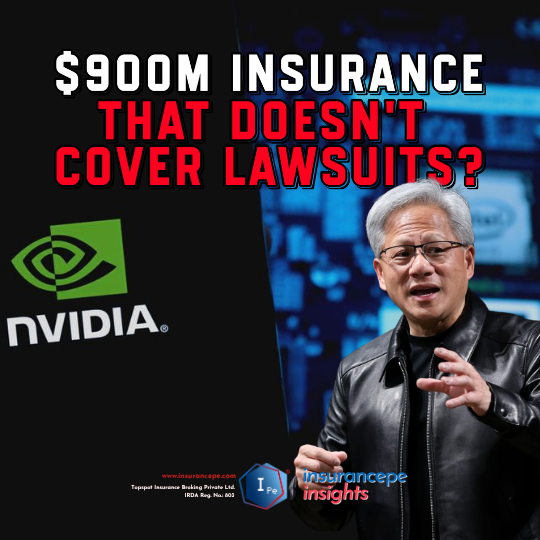
On 9 November 2026, shareholders filed a proposed securities class action in California against Nvidia and Jensen Huang. It alleges they misled investors about Huang’s relationship with an alleged ‘Chinese spy’ who is a former executive of Megaspeed, a chip customer. The allegations have not been tested in court. Huang resigned as CEO and director on 12 November.
Two days later, the Financial Times reported something unusual about Nvidia’s insurance.
What is D&O insurance?
Directors and Officers (D&O) liability insurance covers claims that senior people made wrongful decisions: misleading investors, breaching duties, or violating regulations. A policy is built from three “sides”:
- Side A (personal protection): pays directors and officers directly when the company can’t or won’t indemnify them, for example if it is insolvent or refuses. It also responds to derivative suits, where shareholders sue executives on the company’s behalf.
- Side B (company reimbursement): repays the company when it covers its executives’ legal costs or damages, as companies normally do.
- Side C (entity cover): covers the company itself when it is sued, typically in securities claims.
Most listed companies buy all three. A 2018 Willis Towers Watson survey found more than 80% of US public companies carried full coverage.
This is Nvidia’s insurance “reportedly”
According to the FT, Nvidia bought up to $900 million of Side A cover through broker Aon, with Beazley, AIG and Chubb reportedly among the insurers. Side B and Side C are reportedly missing/ excluded. Neither Nvidia nor the other parties in their insurance arrangement have commented, so this information is not confirmed.
If it’s true that Nvidia has only Side A coverage, the consequences are as follows:
- The class action against the company is a Side C-type claim, so Nvidia’s defence costs and any settlement would come from its own funds.
- Without Side B, what Nvidia spends defending its executives is not reimbursed either.
A Side A-only structure is rare among large listed companies and that large US companies usually also buy Side C because of high litigation exposure.
Why might Nvidia have chosen this?
Once again, Nvidia has not commented or explained, so these remain informed views:
- Cost. Some companies skip B and C because insuring a large listed group could be prohibitively expensive.
- The self-insurance argument. Investor Bill Gurley says every D&O programme has a cap, that premiums include the insurer’s margin, and that large programmes can attract lawsuits because coverage is disclosed early in a suit.
- The balance sheet. Nvidia held $56.6 billion in cash and marketable securities at the end of July 2026 against $33.4 billion of notes, and generated $96.7 billion of free cash flow in the year to January 2026. According to analyst estimates, it earns a $900 million limit’s worth of cash in under two days.
- Uninsurable elements. Regulatory fines and penalties are uninsurable. The larger risk reported for Nvidia is a US government inquiry into Megaspeed, which no D&O structure would have solved.
D&O in India…
Regulation 25(10) of SEBI’s LODR Regulations requires the top 1,000 listed companies by market capitalisation to buy D&O cover for their independent directors. Notably, the rule does not require Side B or Side C, or any minimum limit.
Section 197(13) of the Companies Act, 2013 lets a company pay the premium for insurance covering its managing director, whole-time directors, CEO, CFO and company secretary, without treating it as remuneration unless the person is proved guilty. For private companies and start-ups, D&O is voluntary.
In the insurance industry, D&O cover is compulsory as required by the regulator IRDAI.
Does your company need all three side covers?
Side A (the most important) It protects individuals precisely when the company is least able to, such as insolvency, and independent directors are most exposed then. A dedicated limit for independent directors, so that executives can’t exhaust the whole policy can be considered.
Sides B and C are balance-sheet decisions. Side C is built for securities suits, which are most common for companies with US listings or US investors. Indian companies without that exposure may care more about the quality of Side A and the cover for regulatory investigations. Side B matters if you routinely indemnify executives and want that cost recovered.
It seems Nvidia’s choice arises out of its balance sheet. A company with tens of billions in cash can absorb a legal bill, but a mid-sized Indian company that self-insures its entity risk could be hurt badly by one.
So, if you’re planning to buy insurance for your company, ask:
- Which sides do we need, and at what limits?
- Is there a dedicated limit for independent directors?
- Did we contact @insurancepe?
This blog post is brought to you by the minds at insurancepe!
Got questions or doubts about anyone insurance?
Need advice or help understanding your insurance needs?
Want the best bang for your buck when buying insurance?
We got you!
Reach out to us at:
Whatsapp/Phone: 89779 18030
E-mail: contact@insurancepe.com
Visit us at www.insurancepe.com