
Nepal Flash Flood 2026
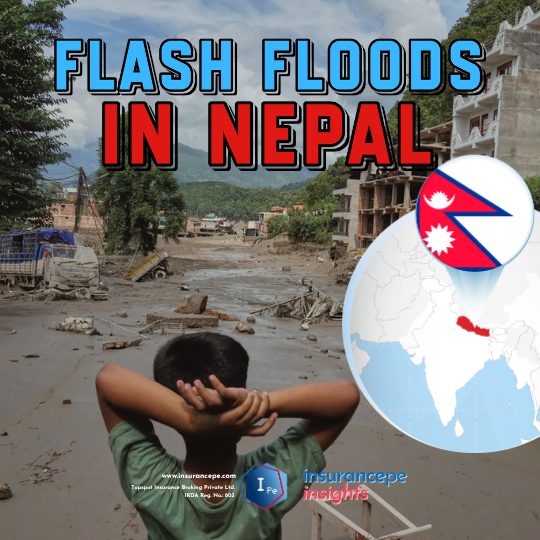
At 8:37 in the morning on 26 August 2026, a vast section of glacier and rock detached from a glacierised slope near the Nepal-China border in the Rasuwa district. It registered as a magnitude 5.2 earthquake on seismometers. As the debris collapsed into the Lhende Khola, a tributary of the Bhotekoshi river, it formed a temporary dam. When the dam failed minutes later, a wall of water, sediment, and debris surged downstream without warning, a 72-kilometre stretch of the Trishuli valley.
At least 903 deaths and 4,247 missing have been confirmed in Nepal, with an additional 16 dead and 546 missing in Tibet. The flood carried the bodies of some victims 240 kilometres downstream into India. Among the missing are hundreds of Indian pilgrims who had been on the Kailash Mansarovar route through Nepal.
The disaster damaged 15 hydropower projects, destroyed 35 motorable bridges, 45 suspension bridges, and wiped out a 40-kilometre stretch of road. The Gyirong border crossing between Nepal and China, a critical trade route, remains inoperable. The BBC described it as the deadliest disaster to strike this stretch of the Himalayas in a generation.
And the scientists are clear on the cause: climate change melted the glacier to the point of catastrophic instability.
Billions lost in infrastructure, who pays?
Nepal’s Trishuli-Bhotekoshi valley is the backbone of the country’s energy future, one of the most hydropower-dense stretches of river in Asia.
The preliminary assessment by Nepal’s Electricity Authority estimates losses running into hundreds of billions of Nepali rupees across the sector. Confirmed damaged projects include the 111MW Rasuwagadhi Hydropower Project, which has been completely washed away, the 22MW Chilime, which has been buried, the 216MW Upper Trishuli-1 under construction, the 60MW Upper Trishuli A, and at least eight other operational and under-construction facilities. Nepal’s stock market moved sharply, the non-life insurance index dropped nearly 400 points in a single day, as investors reacted to the scale of claims exposure.
Hydropower projects in Nepal are generally insured, often with coverage placed through Nepali insurers who then cede significant portions to the international reinsurance market. Nepal’s Insurance Authority has confirmed that licensed surveyors are being deployed to begin damage assessments, but the scale of destruction and the ongoing search-and-rescue operations have taken priority.
According to ratings agency AM Best, insurance penetration levels in Nepal are among the lowest in Asia, and the direct financial exposure of non-life insurers is likely to be modest relative to total economic losses, but international reinsurers are expected to absorb a significant share of insured losses, particularly from hydropower and engineering risks.
Travel insurers covering Nepal are also expected to face claims from trip cancellations, curtailments, and emergency medical evacuations, given that the affected areas are major trekking and pilgrimage destinations.
But uninsured losses arising from homes, farms, bridges, roads, riverside communities, will be borne by the people who had nothing.
The smallest carbon footprint, yet the highest price paid
Nepal emitted approximately 59 megatonnes of CO₂ equivalent in 2024, accounting for roughly 0.1% of global emissions. Over its entire recorded history since 1751, Nepal has contributed just 0.01% of cumulative global CO₂ emissions. At 0.5 tonnes of CO₂ per capita annually, Nepal’s individual carbon footprint is among the lowest on the planet, a fraction of India’s 2.0 tonnes, negligible against the United States’ 14.9 tonnes, and China’s 8.4 tonnes.
Nepal did not industrialise its way through the 20th century. Nepal did not build coal power stations. Nepal did not run millions of petrol cars. Nepal’s forests still cover nearly 45% of the country. And yet Nepal ranked 10th among the world’s most climate-vulnerable nations on the ND-GAIN Index, faces glacial lake outburst floods with increasing frequency, this same river corridor suffered a major GLOF in July 2025, just fourteen months before this catastrophe, and has now lost over a thousand lives and billions in infrastructure to a glacier collapse that scientists directly attribute to climate change.
This is the defining injustice of the climate crisis. The nations that have contributed least to global warming are bearing its most extreme consequences.
How this concerns India…
The Himalayas are the shared inheritance and shared risk of the entire subcontinent.
The same glacial systems that feed the Trishuli also feed the Ganges, the Brahmaputra, and virtually every major north Indian river. The Uttarakhand glacier collapse of 2021 killed dozens and destroyed hydropower plants in the Dhauli Ganga valley. Glacial lake outburst floods have struck Himachal Pradesh repeatedly.
India, with 1.4 billion people and the world’s third-largest carbon footprint in absolute terms, has both a compelling interest and a corresponding responsibility in this story. The Himalayas do not respect borders. What melts above Nepal eventually floods below it. The disaster that struck Rasuwa on 26 August is not a foreign event but a regional one, and a preview of future climate disasters.
Insurance cannot stop a climate disaster but…
Until humanity collectively decides to stop burning fossil fuels at the scale and pace required to halt warming, glaciers will continue to melt, floods will continue to intensify, and disasters of this kind will not only recur, they will worsen. The scientific consensus on this is unambiguous, and the IPCC has projected that under current emission trajectories, the Hindu Kush Himalayan glaciers could lose up to 80% of their volume by 2100.
That is a political and civilisational challenge. It will not be solved by any single country, company, or individual, and it will certainly not be solved by an insurance policy.
But while that larger battle is fought, in international climate negotiations, and election campaigns, the question of who bears the immediate financial cost of each disaster is one that insurance answers. In Nepal, where the insurance penetration rate (Life: 2.98% and Non-life: 0.74%) recovery at a personal level will likely be measured in years of poverty, not weeks of claims processing.
Insurance will not reverse climate change. But it is the only mechanism that converts catastrophic loss into survivable loss.
This blog post is brought to you by the minds at insurancepe!
Got questions or doubts about anyone insurance?
Need advice or help understanding your insurance needs?
Want the best bang for your buck when buying insurance?
We got you!
Reach out to us at:
Whatsapp/Phone: 89779 18030
E-mail: contact@insurancepe.com
Visit us at www.insurancepe.com